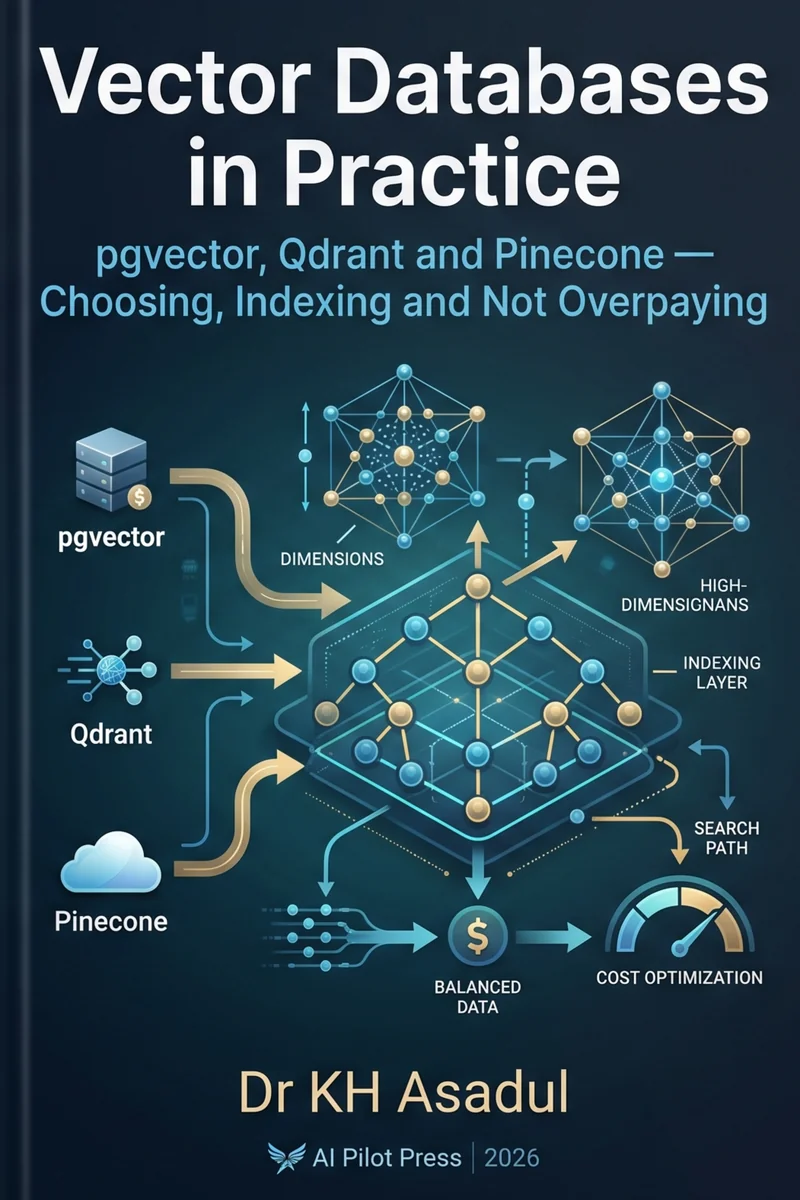
Vector Databases in Practice
pgvector, Qdrant and Pinecone — Choosing, Indexing and Not Overpaying
Compare practical approaches to vector storage with pgvector, Qdrant, and Pinecone. Explore selection, indexing, and cost considerations to make a more informed choice for your application.
View on Amazon ↗Opens Amazon in a new tab. Check the listing for formats and availability.
About this book.
Your embeddings work. Now what actually stores them?
Vector Databases in Practice is the hands-on guide for developers who already have embeddings — from a RAG pipeline, a search feature, a recommendation engine — and need somewhere real to put them, without guessing which of pgvector, Qdrant, or Pinecone is the right call.
Across sixteen chapters, you'll load a real 26,872-row customer-support dataset into all three stores side by side, choose and tune an index (HNSW, IVFFlat), combine vector similarity with metadata filters and full-text keyword search, benchmark p50/p95 latency and recall against your own exact brute-force baseline, and build a zero-downtime migration plan for the day your embedding model changes. Every example runs against a specific, dated stack — PostgreSQL 16 with pgvector 0.7, Qdrant 1.10, Pinecone's serverless API, and Python 3.11 — so nothing here is left to guesswork.
Every book in the From Keyword to Code series states its actual cost
running every example in this book, against the full dataset, comes to under ten cents in embedding calls. pgvector and Qdrant run free on your own machine; Pinecone's free serverless tier covers everything this book asks it to store.
By the last chapter, you won't just have three working demos — you'll have a benchmark harness, a four-question decision framework, and a capstone project run against your own data, so the next time someone asks "which vector database should we use," you'll have your own numbers, not someone else's opinion.
Reader resources.
Includes a README with setup notes and a chapter-by-chapter file index.
Official documentation and guides for topics covered in this book.
← Back to the books